2027 details will be announced in December
DIVERSEartPB 2026
The Biennials and Art Institutions in the Contemporary Art Ecosystem
DIVERSEartPB 2026 is a living examination of how contemporary art circulates, interfaces, and evolves across a global ecosystem of biennials and art institutions. This year, we present seven international Biennials, including Gwangju Biennial (Korea), Cuenca Biennial (Ecuador), NYLAAT Triennial (New York), SACO Biennial (Chile), and NoMade Biennial along with other significant platforms and leading institutions, all positioned within a shared ecological frame.
Since its founding in 1895, the Venice Biennale has remained the most influential model. After World War II, biennials and triennials across cities like São Paulo, Istanbul, and Johannesburg expanded global representation, embracing social critique and experimental media while navigating tensions around inclusion, markets, and cultural diplomacy.
Biennials invite urgency, experimentation, and immediacy. They illuminate emergent practices, foster cross-disciplinary collaboration, and host field-wide dialogues beyond the walls of traditional museums.
Art institutions provide durable memory, methodological rigor, and sustained programming, ensuring innovations are archived, contextualized, and accessible to future generations. Together, they form a dynamic continuum: sparks of innovation followed by reflection, stewardship, and dissemination, keeping the field responsive to diverse publics.
In Latin America and other regions contending with rapid sociopolitical change, biennials are re-emerging as laboratories of critical thought. They read and rewrite the conflicts of our time, migration, memory, community, body sovereignty, and territory, while foregrounding sustainability and resilience.
This edition pays particular attention to place: how venues, geography, and local communities shape biennial and museum activities, and how those activities, in turn, shape place through curatorial interventions, community projects, and participatory formats. You may encounter AGUAS, and other works that foreground care, connection, and collective action as a mode of inquiry and transformation.
DIVERSEartPBis curated by Marisa Caichiolo
CASABLANCA BIENNIAL 2026 (Morocco, Africa)
PROJECT: AQUAS
ARTIST: EUGENIA VARGAS PEREIRA
CURATOR: MARISA CAICHIOLO
BOOTH 707
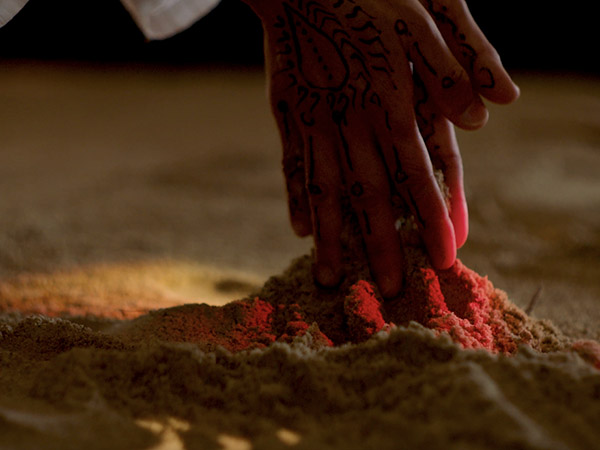
AGUAS is an ongoing exploration of rivers, inviting community participation through a ritual of river cleansing. For DIVERSEartPB, the artist presents AGUAS, centered on the river canals in Palm Beach. The installation simulates a large-scale analog darkroom, going beyond mere aesthetic expression.
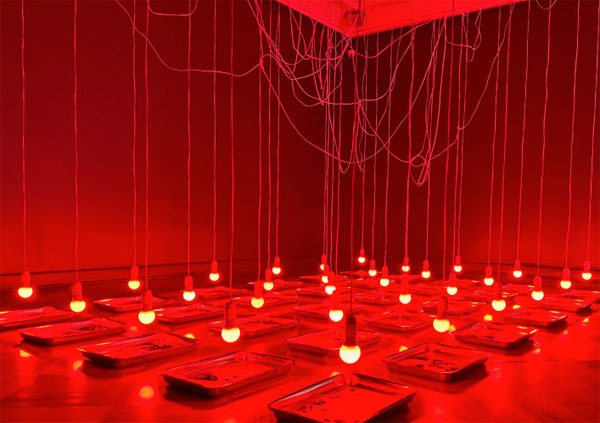
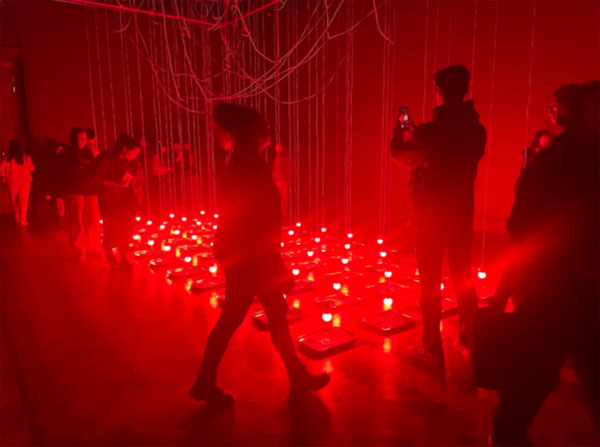
The work consists of 55 developing trays, each illuminated by an amber or red light bulb suspended from the ceiling with white electrical cables. These cables emerge from a tangled mass overhead, forming an intricate network above the trays. Within each tray, a photograph of a woman or man interacting with the river is submerged in water. The installation evokes a space where images slowly emerge and fade – mirroring the tragic and relentless transformation of the natural world under the pressures of climate change and human neglect. Yet within this slow vanishing lies a quiet potential: a reminder that when we come together – with awareness, creativity, and care – we can interrupt the cycle and shape a more compassionate relationship with the Earth.
More than a visual experience, AGUAS becomes a space for contemplation. Community is the heart and soul of this project. AGUAS becomes not just a meditation on environmental degradation, but a collaborative act of care, listening, and restoration.
Eugenia Vargas Pereira has participated in numerous Biennials, including the Havana Biennial, Aperto X Venice Biennale, XX Biennial of Photography in Mexico City, Biennale Rotterdam, Casablanca Biennale, and the 50th Venice Biennale, among others.
PAJU CULTURAL FOUNDATION (PAJU, KOREA) & CULTURE NOMAD (SEOUL, KOREA)
PROJECT: BIRTH OF LIGHT
ARTIST: SUNG MIN JANG
CURATOR: MONICA HYE YEON JUN, IN COLLABORATION WITH
INTERNATIONAL ASSOCIATION FOR ART ECOSYSTEM RESEARCH (IAAE)
BOOTH 705
Birth of Light does not simply refer to the state of being alive – it marks the primordial moment when humanity first encounters the world, the threshold where consciousness meets existence. Through a cyclical rhythm of creation and dissolution, the work meditates on the recovery and reverence of life itself: the essence of being human, the sanctity of existence, and the sensibility that binds us to the living world.
Composed of over a hundred suspended structures, the installation transforms the space into a breathing organism. From the ceiling, delicate forms made of hanji and internal frames cascade downward, filling the air with a subtle choreography of light and shadow. As illumination shifts and reflections intertwine, the work generates an organic rhythm – one that seems to pulse with life. Walking slowly through the installation, the viewer becomes immersed within what feels like the inner membrane of a living cell, surrounded by the quiet pulse of existence. The golden hue that permeates Birth of Light resonates across cultures as a symbol of divinity, vitality, and renewal. Here, light is not treated as a fixed form but as a living presence- breathing, reflecting, and responding. Each illuminated element converses with others, creating a field of mutual resonance. The viewer, moving within this ecosystem of light, is invited not merely to observe but to participate – to sense their own vitality mirrored in the luminous breath of the space. Ultimately, Birth of Light expands beyond the realm of an artwork. It becomes a living ecology where matter, energy, and perception converge – an ever-evolving symphony of connection that reawakens our collective memory of what it means to be alive.
*Paju Cultural Foundation is a public cultural institution based in Paju, a city shaped by its proximity to the DMZ – one of the most symbolically charged landscapes of the 20th century. Working at the intersection of place, memory, and contemporary practice, the Foundation develops site-responsive and research-driven art projects. It supports artists and curators through exhibitions, residencies, and public programs that engage local and global perspectives. Through active collaboration with international partners, the Foundation cultivates spaces for dialogue, reflection, and cultural exchange.Positioning art as a medium of connection and regeneration, the Foundation explores how culture can reimagine contested geographies and shared futures.
*The International Association for Art Ecosystem Research(IAAE) was established to examine and interconnect the relationships among artistic creation, space, institutions, regions, and society through the lens of an ecosystem. The Association understands art not as isolated works or singular events, but as a living structure in which humans and environments, memory and place, continuously interact. Through research, exhibitions, education, and international exchange, it bridges regionally grounded artistic practices with global critical discourse, seeking models for sustainable art ecosystems. The Association critically explores how art can contribute to social transformation and the formation of public value. Ultimately, the International Association for Art Ecosystem Research positions itself as an open research platform that restores relationships through art and fosters new ways of imagining the future.

WORLD TEXTILE ART BIENNIAL (MIAMI)
PROJECT: TEMPUS FUGIT
Textile multi-disciplinary installation
ARTIST: IXCHEL SUAREZ
CURATOR: PILAR TOBON
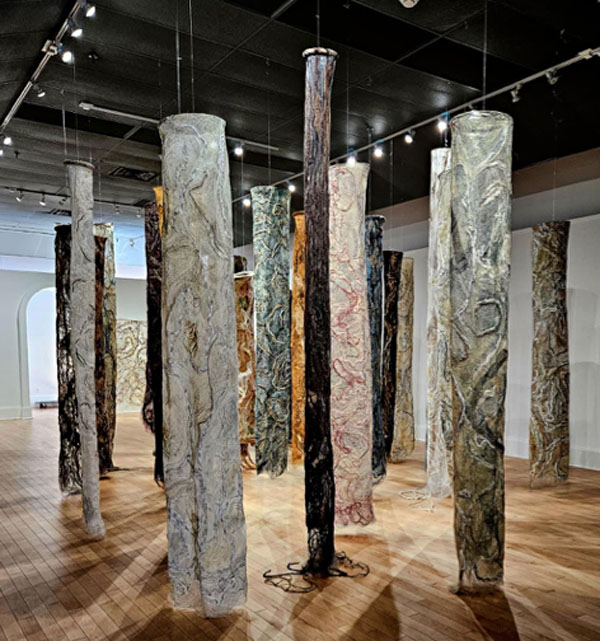
Tempus Fugit—Latin for time flies—is a contemplative, immersive textile installation composed of 35 tree-form embroidered contemporary light quilt-sculptures, accompanied by video by Esteban Powell and original music composed by Dimitar Pentchev (In Memoriam). Conceived as an environmental and poetic meditation, the work invites viewers into a suspended forest where fibre, light, sound, and moving image converge to embody the fragile passage of time.
Each quilt-sculpture stands as a living witness: layered, stitched, and illuminated surfaces evoke growth rings, scars, and renewals—records of lived time embedded in cloth. Hand embroidery becomes an act of remembrance and resistance, slowing the viewer’s gaze in a world driven by speed and impermanence. The tree forms echo humanity’s enduring relationship with nature, suggesting resilience while acknowledging vulnerability, loss, and decay.
Projected imagery moves gently through the installation like breath or memory, expanding the textile landscape beyond the physical into a temporal realm. Sound, composed in memoriam, carries a quiet elegiac presence—at once intimate and universal—guiding the body through space while marking absence, transition, and continuity. Together, video and music do not illustrate the textiles; they converse with them, weaving an atmosphere where silence, vibration, and light become material.
Tempus Fugit is both elegy and offering. It speaks to collective histories, ecological precarity, and the human need to mark time through making. Rooted in traditional textile language yet fully contemporary, the installation affirms fibre as a living archive—where art holds time, and time, fleeting as it is, briefly becomes tangible.
SELECTED INTERNATIONAL BIENNIALS BY MARISA CAICHIOLO
N
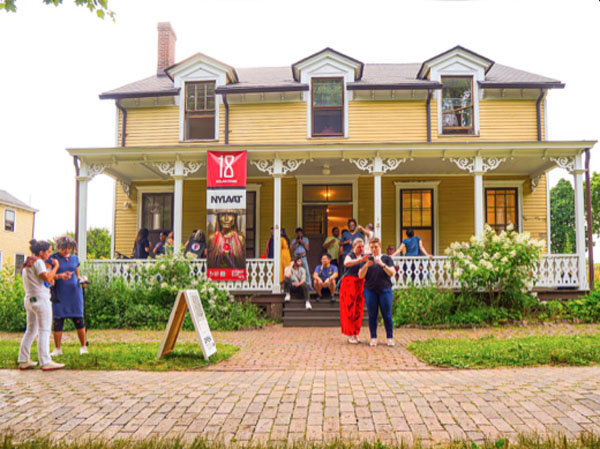
NEW YORK LATIN AMERICAN TRIENNIAL – NYLAAT (NEW YORK, USA)
The New York Latin American Art Triennial (NYLAAT) has established itself as one of the most active institutional platforms dedicated to the promotion, research, and dissemination of Latin American art in the United States. With an internationally oriented curatorial model and a network of venues across New York City, the Triennial advances initiatives that strengthen Latin America’s cultural presence in one of the world’s most influential artistic capitals.
Its programming encompasses large-scale exhibitions, artist residencies, educational projects, specialized publications, and ongoing collaborations with museums, universities, and cultural organizations. These efforts foster a transnational dialogue that connects artists from Latin America and its diaspora with global audiences, expanding opportunities for recognition and visibility within the international art circuit.
More than a periodic event, NYLAAT functions as a dynamic institution that researches, supports, and amplifies diverse contemporary practices. Its mission is to create spaces of recognition for the multiple voices of Latin American art, promote new critical perspectives, and contribute meaningfully to the strengthening of Latin America’s presence within the global cultural landscape.
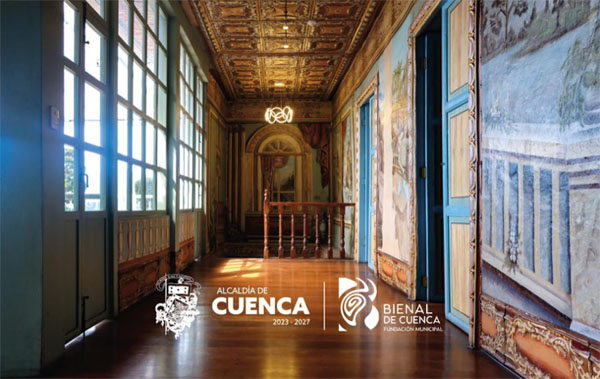
CUENCA BIENNIAL (ECUADOR) – 40-YEAR ANNIVERSARY
The Game: Biennial of Biennials
The documentary addressing the XVII Cuenca Biennial unfolds as a visual research tool that, through the lens of play, explores the dynamics that influence the artistic and curatorial creation of this edition. Here, the camera acts as an epistemological resource that offers the opportunity to observe the phases of creation, their tensions and methodologies, unveiling the procedural aspect of each proposal and its staging.
Play, seen as a mental strategy, an experimental environment, and a flexible structure of meaning, becomes the core for analyzing the practices of the artists and curators involved. Each proposal is considered from an angle that highlights its internal logic, its systems of rules, its trial-and-error methods, and the shaping of alternative worlds. Likewise, the film investigates the curatorial role as an act of translation, negotiation of ideas, and mediation that organizes meanings within the exhibition space.
Through a meticulous approach, the visual record emphasizes the connections among curators, artists, works, conflicts, and staging; the critical actions that support each work; and the reflective processes that shape each exhibition. Thus, the film, in addition to capturing the process of installing the XVII Biennial, generates knowledge about it, positioning play as a category of analysis and a practice that shapes the artistic and curatorial dynamics of contemporary art.
NOMADE BIENNIAL
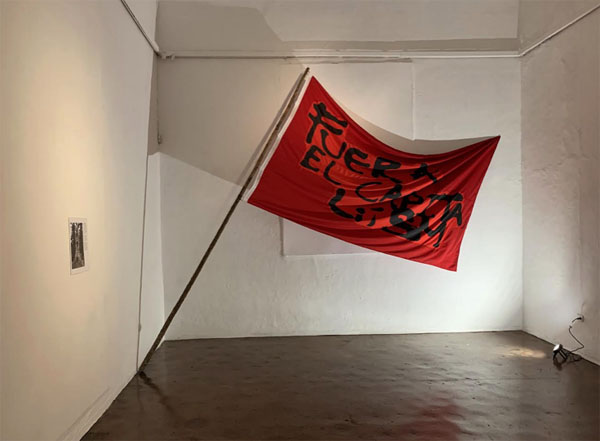
Nomade Biennial is a project created by the critic and curator Hernán Pacurucu from Ecuador and the visual artist and independent Chilean curator Víctor Hugo Bravo, from 2015 to the present. It is a space in transit, a multiple collectivity that, from autonomous and independent production, generates a series of reflections on the systems and visibility of contemporary art. A collectivity in transit generating thought, addressing border or institutional exhibition spaces, conducting workshops, publications of books, conferences, mobile residences, settlements, and multiple interdisciplinary alliances as a platform, a biosphere of autonomous economy, which articulates other forms of human relationship rooted in utopias, experiments, mistakes, and reflections in relation to the context.
Articulating a political and emotional view of the new forms of social gathering, fundamentally anchored in collaborative work and affects. Creating multiple networks that generate work nodes, enabling spaces and bringing people together under a common ideological umbrella. Cultivating from artistic creation possible scenarios of communication and coexistence that shape society. Nomade configures new ways of understanding the biennial format, developing a series of deconstructive strategies.
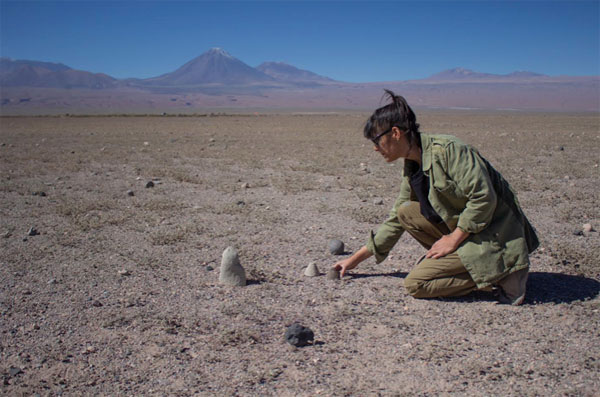
SACO BIENNIAL (CHILE)
SACO Corporation is a nonprofit cultural organization that positions itself internationally due to the impact of its management and its quantitative and qualitative results in the major copper and lithium mining capital. Its work has expanded the visual arts in Latin America through exhibitions, research at the intersection of art and science, educational programs, interventions in natural spaces, and artistic residencies in the world’s driest desert.
Since 2012 it has developed the SACO Contemporary Art Biennial. Each edition is carried out under a different curatorial concept and is distinguished by its “museum without a museum” program, which transforms places not necessarily tied to culture into spaces where the community encounters art. Following the exhibitions, the artwork materials are reused, under a pioneering circular economy logic in the international biennale ecosystem. In addition to exhibitions, SACO organizes residencies, in which artists from around the world can approach the planet’s clearest skies, engage with the indigenous cultures of the region, and connect with leading scientists in fields related to the Atacama Desert, such as geology, microbiology, astronomy, among others.
The corporation’s mission is to establish a permanent center of reflection and dialogue through the artwork, addressing the absence of institutions dedicated to pursuing these aims in the Antofagasta region. All its educational activities come together in its permanent education program, a school without a school. To date, the Corporation’s activities have been carried out in Chile, Argentina, Mexico, Colombia, Brazil, Germany, Ecuador, Spain, Switzerland, Poland, and Norway.
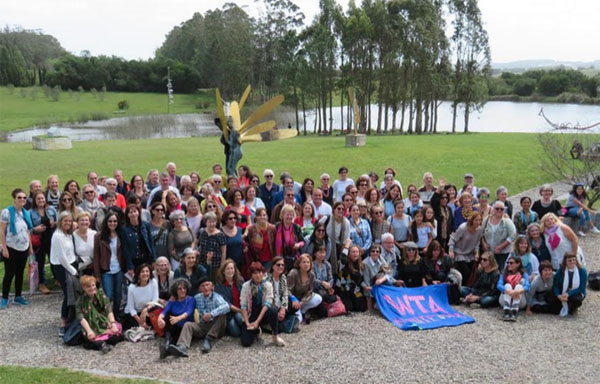
WORLD TEXTILE ART BIENNIAL (MIAMI)
The WTA Organization was founded in 1997 in the city of Miami, Florida, United States, under the name Women in Textile Art. Pilar Tobón, a curator and Colombian textile artist, posed this great challenge given the need to reclaim textile art at local and global levels. Tobón has always pursued the objectives of supporting, disseminating, promoting, and fostering textile artists and their works.
In 2009, given the inclusive and universal character of textile art, the name was changed to World Textile Art. The World Textile Art Biennial has been held since 2000. It has taken place in the United States (2 editions), Venezuela, Costa Rica, Argentina, Mexico, Uruguay, Spain, and Chile.
To meet the outlined objectives, the director created the WTA Contemporary Textile Art Biennial, nomadic in nature, unique in its kind in the world. This first version was held in 2000 at the Museum of Latin American Art of Florida. With the Biennial, local cultural practices and the natural and human diversity of the host country are promoted and disseminated to visitors from around the world who attend the great textile gathering.
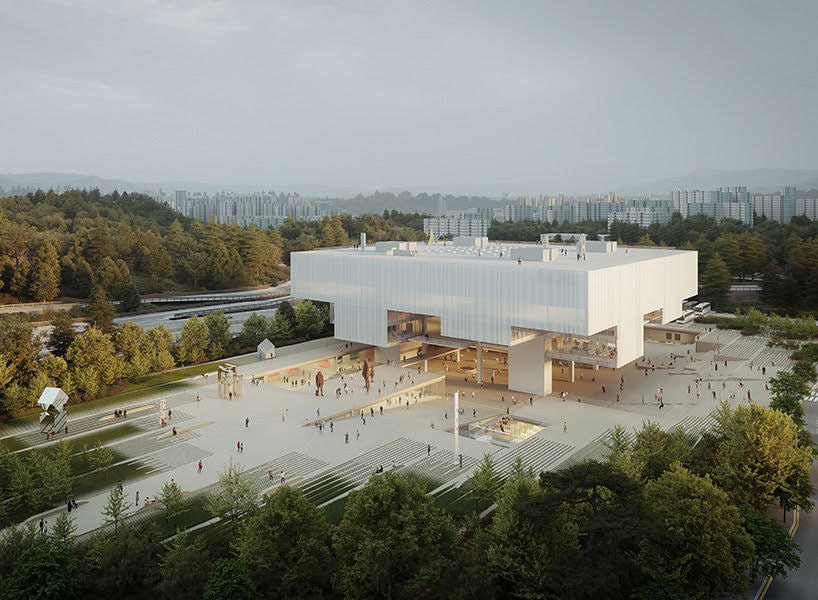
GWANGJU BIENNIAL (KOREA)
The Gwangju Biennale is an international contemporary art event founded in South Korea in 1995, established in memory of the 1980 Gwangju Democratization Movement. It is one of Asia’s oldest and most prestigious biennials, held every two years, and features exhibitions, performances, and educational programs from around the world. Hosted by the Gwangju Biennale Foundation and the city of Gwangju, it serves as a platform for cultural exchange and discourse, with a mission to promote art, cultural history, and the city itself.
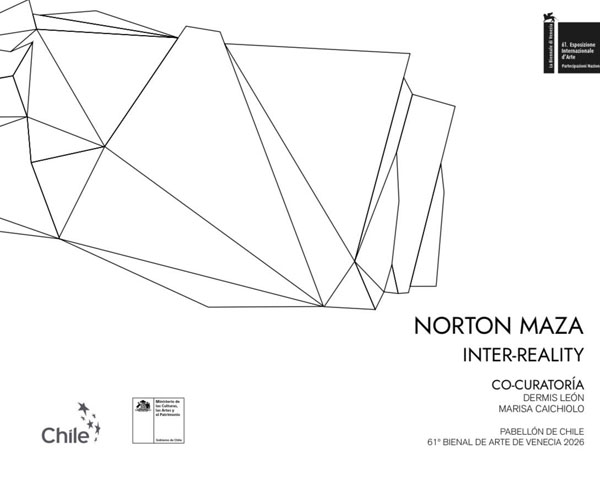
61ST VENICE BIENNALE 2026
OFFICIAL PAVILION OF CHILE AT THE ARSENALE
CO-CURATED BY MARISA CAICHIOLO & DERMIS LEÓN
Inter-Reality, by artist Norton Maza, curated by Marisa Cachiolo and Dermis León and managed by Claudia Pertuzé, also as part of the team Beatrice Di Girolamo and architect Mathias Klotz, was selected to represent Chile at the 61st Venice Art Biennale, an event to be held from May 9 to November 22, 2026, in the Italian city. Chile’s participation in the Venice Biennale is the result of inter-institutional collaboration between the Ministry of Cultures, Arts and Heritage, through its Secretariat of Visual Arts, the Ministry of Foreign Affairs, through the Division of Cultures, Arts, Heritage and Public Diplomacy (DIRAC), and the Embassy of Chile in Italy.
DIVERSEartPB 2025
ART HAS THE POWER TO CHANGE THE WORLD
The evolving role of museums: fostering relevance in a changing world
Art possesses a transformative power that serves as a catalyst for global change and unity. It resonates on a profound level, connecting individuals and inspiring collaborative efforts toward a brighter and better future. Through diverse forms of artistic expression, we transcend boundaries of nationality, culture, and language, forging deeper connections that enrich our shared humanity. Art uniquely expands our consciousness, shifting our focus from individual perspectives to a collective mindset. It bridges the gap between the local and the global, promoting understanding, empathy, and solidarity among diverse communities worldwide.
Engaging with art not only allows us to appreciate its beauty but also empowers us to challenge societal norms, reshape perceptions, and ignite positive social change. Art stands as a formidable force for transformation, uniting people and paving the way for a more harmonious and interconnected world.
The DIVERSEartPB 2025 edition, featuring contributions from esteemed institutions such as the Boca Raton Museum in Florida, the Museum of Contemporary Art of the Americas (MOCAA), the Danubiana Museum in Bratislava, Culture Nomad in Seoul, and ReflectSpace & Library Arts and Culture in Glendale, California, underscores art’s extraordinary ability to connect humanity and inspire a more unified future. This edition opens a vital conversation about the transformative potential of museums and art institutions as they redefine their roles in an ever-evolving landscape. Together, we can explore how these spaces can become dynamic catalysts for community engagement, social dialogue, and cultural exchange, ensuring that they remain relevant and impactful in a rapidly changing world. This version aims to create a more compelling narrative while emphasizing the importance of art and museums in fostering connection and change.
DIVERSEartPB is curated by Marisa Caichiolo.
DIVERSEartPB Museum Acquisition Award
DIVERSEartPB 2025 is proud to announce the second edition of the Museum Acquisition Award for Emerging Artists in Palm Beach.
Inspired by Spain’s La Neomudéjar Museum to mark its 10th anniversary, this year we are doing the Acquisition Award as a celebration of the 75th Anniversary of a local Museum, BOCA RATON MUSEUM. The winner of the award will be chosen by Museum Curator Katheleen Goncharov and Director Martin Hanahan, as well as Marisa Caichiolo, Curator of DIVERSEartPB. The award will be presented by Art Palm Beach Fair Director Kassandra Voyagis and all the parties involved at the Opening Ceremony of the Fair.
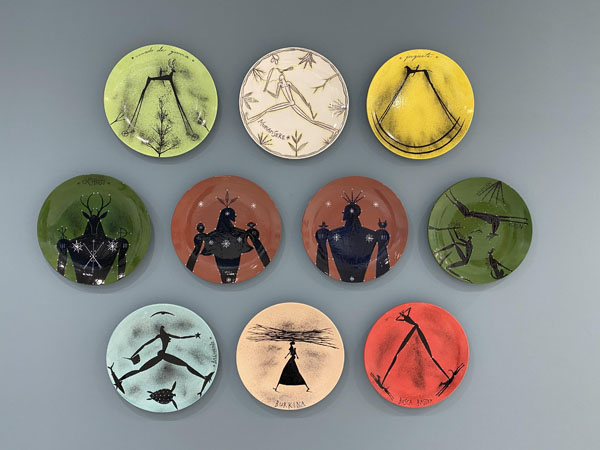
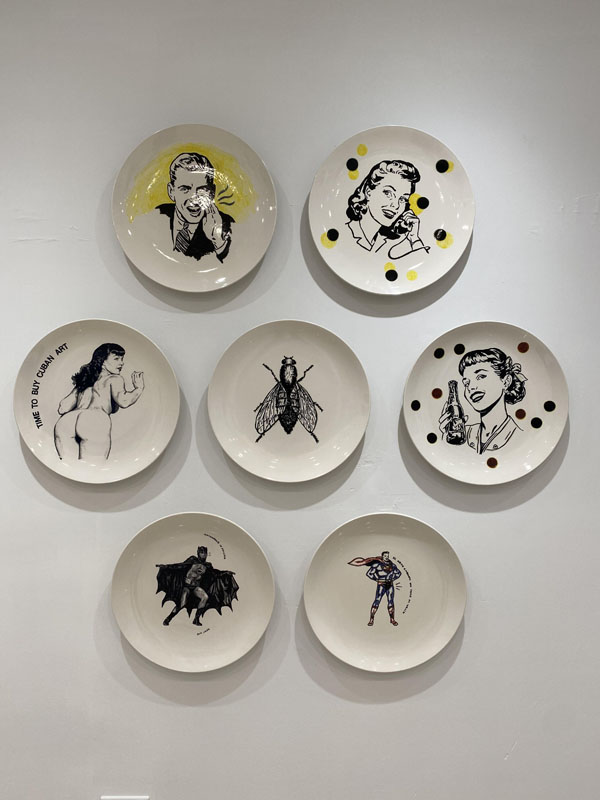
PROJECT: CERAMIC PLATES COLLECTION
PRESENTED BY MOCAA MUSEUM
(Museum of Contemporary Art of the Americas)
The Museum of Contemporary Art of the Americas, located in The Crossings, Kendall, is home to one of the most fascinating collections of ceramic art in South Florida. Through its Fine Arts Ceramic Center, adjacent to the museum itself, dozens of artists have produced remarkable works that have been exhibited in numerous cultural institutions across the United States.
This collection is organized into three primary groups. The first consists of original ceramic plates, all unique and quite possibly among the largest collections of its kind in the country. The second group features murals composed of individually painted tiles. The third includes standalone sculptures and installations.
The plates have been created primarily by Cuban artists, and more recently (2023–2024) by artists from across the continent. This particular collection has garnered the greatest interest and recognition among specialists and enthusiasts, with nearly a thousand plates created by just over a hundred artists. Each piece is unique, hand-painted, and fired at the Fine Art Ceramic Center workshop.
The plate collection includes works by renowned artists, both nationally and internationally, including Gustavo Acosta, José Bedia, Carlos Cárdenas, Humberto Castro, Carlos Estévez, Ivonne Ferrer, José Franco, Lia Galletti, Aimée García, Carlos Luna, Milena Martínez Pedrosa, Rigoberto Mena, Amelia Peláez, Esterio Segura, Alfredo Sosabravo, Rubén Torres Llorca, among many others. To date, a total of 97 artists have contributed to this collection, with most creating between four and twelve unique, original pieces.
PROJECT: GLASSTRESS
ARTISTS: NATHALIE DJURBERG & HANS BERG
CURATOR: KATHLEEN GONCHAROV
PRESENTED BY BOCA RATON MUSEUM of ART
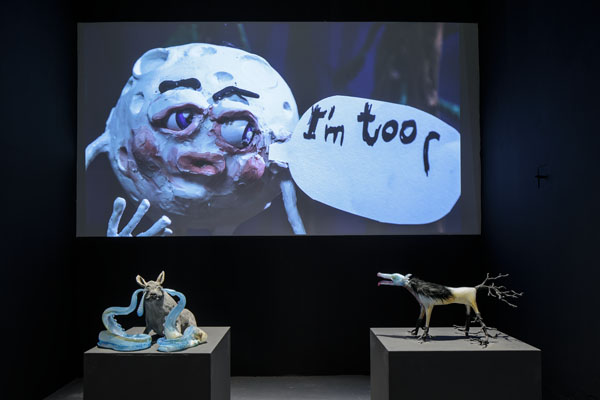
The Boca Raton Museum of Art will present a video and glass sculptures that will be included in its upcoming Glasstress exhibition (April 23-October 26, 2025). Glasstress, based in Venice, brings international contemporary artists to its furnace in Murano to collaborate with its glass masters. The video by the artist duo, titled Howling at the Moon, is a stop-motion animation that is a fantastical and surreal fairy tale in which a wolf tries to convince the Moon to take a sow he possesses. Glass versions of the sow and the wolf are presented along with the video.
GLASSTRESS 2025
BOCA RATON MUSEUM OF ART
APRIL 23 – OCTOBER 26, 2025
The upcoming exhibition at the Boca Raton Museum of Art features work by renowned international contemporary artists in collaboration with glass maestros at the Berengo Studio on the Lagoon Island of Murano.
The Studio was founded by Adriano Berengo in 1989 to support artists who wish to experiment with glass as a medium. Another purpose is to revive a Venetian glass industry that dates from 450 AD but is now challenged by faux Murano glass made in China and sold to unsuspecting tourists. The project also fosters innovation in that its artisans are spurred to develop new techniques when challenged by artists. Berengo was inspired in part by the efforts of Peggy Guggenheim, who invited artists such as Picasso and Chagall to work with skilled artisans on Murano in the 1960s.
Some of the works visitors will see when they visit the Boca Raton Museum of Art next Spring are an enormous chandelier by Ai Wei Wei, a monumental multi-colored stack of cast glass by Sean Scully, installations by Laure Prouvost, Monica Bonvincini, Thomas Schütte, and new works by María Magdalena Campos-Pons and Tony Cragg.
Howling at the Moon by the Swedish duo Nathalie Djurberg & Hans Berg presented here at Art Palm Beach will be included in the upcoming Glasstress 2025. The work includes a stop-motion animation paired with two of the film’s protagonists recreated in glass at the Berengo Studio. The film is a surreal fantasy fairy tale featuring an untrustworthy wolf, a mischievous Moon, and a sow. It is a psychological work of darkness and light, satire, and double meanings, set in a world that is both unsettling and oddly familiar. Its enigmatic score is by electronic composer Hans Berg.
The artists live in Berlin and their work has been widely exhibited and collected, including the Museum of Modern Art, New York; Modern Museet, Stockholm; Baltimore Museum of Art; Minsheng Art Museum, Shanghai; Institute of Contemporary Art, Boston; Australian Center for Contemporary Art, Melbourne; Schirn Kunsthalle, Frankfurt; and the Prada Foundation, Milan.
PROJECT: OMINKA
ARTIST: VIKTOR FREŠO
CURATOR: MARISA CAICHIOLO
PRESENTED BY DANUBIANA MUSEUM OF ART
BRATISLAVA, SLOVAKIA
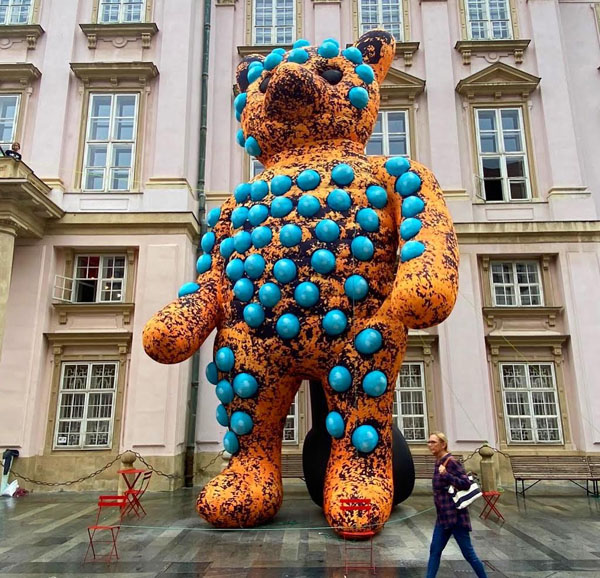
Ominka by Viktor Frešo is a memory embodied in a family artifact transformed into monumental art. This sculpture is based on the story of the artist’s grandmother, a former singer who sacrificed her promising career to support her family. In 1964, she brought a Fool’s Gold brooch from the USA to Slovakia, a memento of her travels and a symbol of her unfulfilled dreams. Decades later, Frešo reinterprets this sentimental object, creating a monumental sculpture that serves as a metaphor for the illusions and fleeting nature of material aspirations – much like the deceptive glimmer of Fool’s Gold.
In this work, Frešo revisits central themes of his practice: the personal archive and the vanity of life. By enlarging this modest piece of costume jewelry into a monumental sculpture, he questions the significance we attach to material objects. The sculpture is both a tribute and a critique, reminding us that what remains after people are not the objects themselves but the stories they carry.
Bringing the sculpture back to the United States, the brooch’s original country of origin, completes a poetic cycle. It symbolizes a return to the roots of a family narrative and concludes a journey that spans generations and geographies. In essence, Frešo’s artwork becomes a reconstructed family portrait, piecing together fragments of his ancestors through artifacts, memories, and their reinterpretation as contemporary art. Since the medium of the work is an inflatable balloon sculpture, the air inside also symbolizes the memories that can never be permanently retained. When the balloon is finally deflated, it reflects the gradual fading of memories over time, carried by the breath that once gave it its shape.
PROJECT: “ETERNAL LIGHT – 21C THE LAST JUDGMENT”
ARTIST: HANHO
CURATORS: MONICA HYE YEON JUN, ARA AND ANAHID OSHAGAN
PRESENTED BY REFLECTSPACE GALLERY, GLENDALE LIBRARY, ARTS & CULTURE (GLENDALE), CULTURE NOMAD (SEOUL)
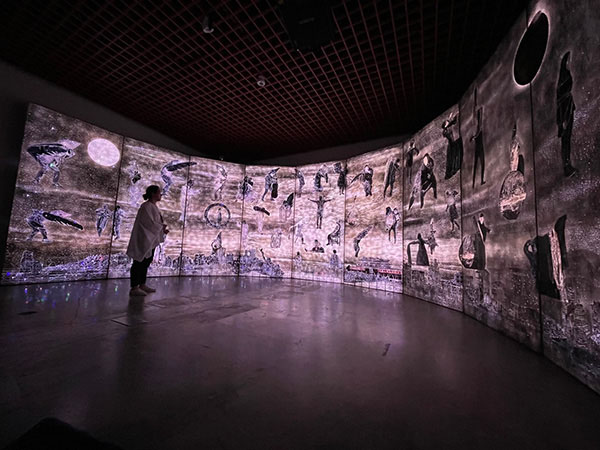
Inspired by Michelangelo’s masterpiece, The Last Judgment, artist HanHo’s Eternal light – 21c The Last Judgment addresses epic human and metaphysical issues. The nine-part massive multi-media panel work re-imagines an apocalyptic end of the world scenario to humanity in the 21rst century – constructing an afterimage of humankind facing wars, colonization, mass displacement, environmental disaster and nuclear annihilation.
Technology is an integral part of HanHo’s work which he combines with traditional art techniques to create multi-colored light-infused immersive worlds that shift and ebb in front of your eye. They challenge perception and teeter on the edge of the metaphysical. Nearly all the figures depicted in the work are the artist himself: identity, memory, performance, history, war, future and fantasy all blend together in this massive panorama of a transcendent humanity.
Synthesizing with the work’s apocalyptic overtones, a mystical “Eternal Light” (as the artist calls it) bathes HanHo’s canvases and elevates his worlds to glimmering and mythical proportions. Will this eternal light uplift humanity from the current slate of wars and genocides plaguing us? Will humanity be able to avoid its own destruction? Who will judge us, finally? These questions under-gird HanHo’s “Last Judgment” and create a space for us to contemplate them and our future.
DIVERSEartPB 2024
Through a range of media and approaches, the edition in 2024 will encourage visitors to explore the complex and evolving relationship between memory, humanity, and AI.
Memory is a fundamental aspect of human experience, shaping our individual and collective identities and informing our understanding of the world around us. As we enter an era of rapid technological change and increasing reliance on artificial intelligence (AI), it is important to consider the role that AI can play in shaping our memory and our sense of humanity.
DIVERSEartPB will explore the intersection of memory, humanity, and AI through a range of artistic and technological perspectives. Through installations, interactive experiences, and thought-provoking artworks, visitors will be challenged to consider the ways in which AI is changing our relationship to memory and shaping our understanding of what it means to be human.
From AI-generated artworks to immersive virtual reality experiences that challenge our sense of self, the works in this edition invite us to consider the opportunities and challenges presented by AI and memory. What does it mean to remember in an age of digital memory? How can AI be used to enhance our memory and our understanding of the world? And what are the ethical and social implications of relying on AI as a tool for memory and identity?
DIVERSEartPB is curated by Marisa Caichiolo, DIVERSEartLA Curator.
DIVERSEartPB Museum Acquisition Award
DIVERSEartPB 2024 is proud to announce the inaugural edition of the Museum Acquisition Award for Emerging Artists in Palm Beach.
Inspired by Spain’s La Neomudéjar Museum to mark its 10th anniversary last year in Los Angeles, the initiative seeks to support the art scene by promoting the acquisition of art works by leading national and international museums. The winner of the award will be chosen by Néstor Prieto and Francisco Brieves, Co-Directors of La Neomudéjar Museum, as well as Marisa Caichiolo, Curator of DIVERSEartLA. The award will be presented by Prieto, Brieves, Caichiolo and LA Art Show Director Kassandra Voyagis in a closing ceremony at the fair.
Project: MUSEUM AI
Artists: Ana Marcos | Alfonso Villanueva
Curator: Nestor Prieto
Presented by LA NEOMUDEJAR MUSEUM – MADRID, SPAIN
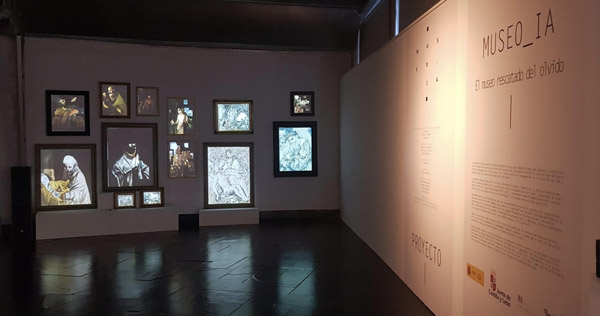
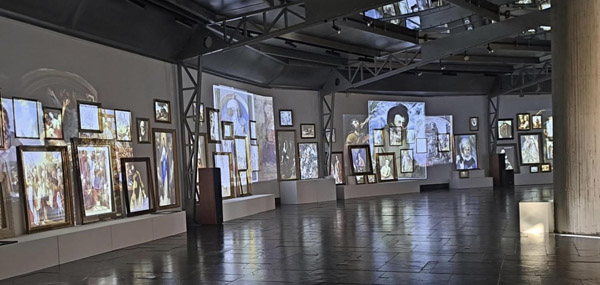
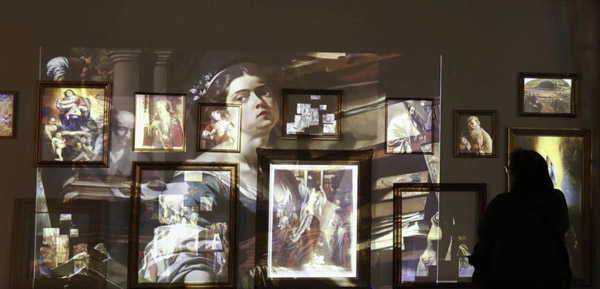
MUSEUM AI is an Artistic Research that uses Artificial Intelligence (AI) to re-image and re-create lost pieces of Art.
The recreation of the collection of 57 lost paintings from Palencia Museum has been the selected collection for this project. This collection disappeared and was largely forgotten and condemned to oblivion until now. MUSEUM AI helps us understand where we come from if we want to achieve appreciation and respect for art, since only knowledge leads to recognition of our memory and cultural heritage.
MUSEUM AI wants to rescue from oblivion the story of a forgotten heritage by proposing an exhibition on lost works of art. And also respond to the question: What would it be like if a machine intelligence, a computer, re-mastered these paintings using learning processes after a rigorous historical study on the available data?
MUSEUM AI is a new collection reborn with the intention of updating, making visible, exchanging and, if possible, transcending the artistic event with a vision of the 21st century. And as in the Computer itself, let this be a continuous sequence in the learning process. A collective and innovative project, that puts in Memory an AI images collection that comes from History and dialogues with contemporary times, shaping images that in the 21st century are based on heterogeneous intelligences and multidisciplinary learning. It is about recognizing that culture is now and increasingly an action shared by millions of people who collectively seek to meet their past to build the future in different ways of expression; that culture is the wealth of people who defend their identity and memory, who try to reinvent themselves in a globalized, multicultural and diverse world.
MUSEUM AI has been supported by the Ministry of Culture of Spain and recently received the EXPONE Award for the best national exhibition 2023.
Project: Mythstories
Artist: Carlos Castro Arias
Curator: Gustavo Adolfo Ortiz Serrano
Presented by MAC – MUSEUM CONTEMPORARY ART – BOGOTÁ, COLOMBIA
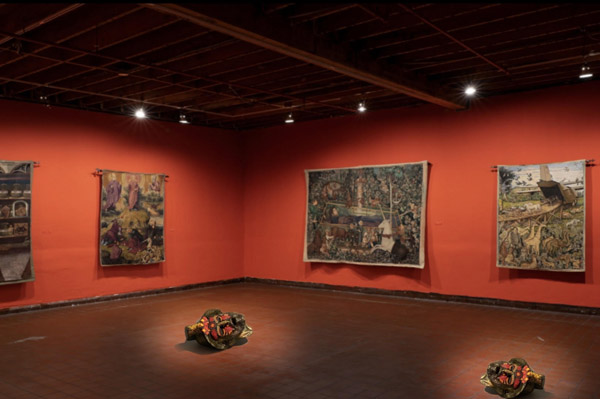
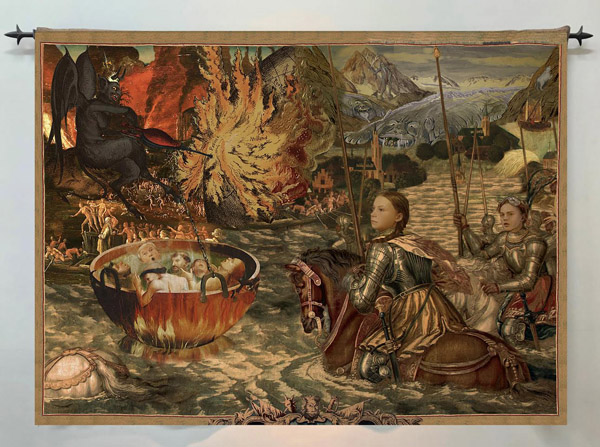
Myths are constructed to express realities beyond logical understanding and to help us comprehend concepts that are difficult to explain with ordinary language. Carlos Castro’s work is situated precisely where contemporary society is confronted with a mirror but is hesitant to open its eyes. By employing the ancient medieval technique of tapestry and utilizing an iconography that connects the ancient and the contemporary, he intricately weaves a new understanding of our recent history within the context of a hyper-communicated, transcultural, hybrid, and meaning-hungry society. In the midst of complexity, it becomes necessary to turn to myth in order to approach our existence in a symbolic and cohesive manner, using a resource that enriches the imagination and emotion required to assimilate the succession of moments that will eventually become history.
Each Castro tapestry is a journey through time, not only through chronological time, but also through the transposition of characters, places, forms of representation, canons, and values. This creates a spiral that enables us to visually and conceptually navigate between a past-present, a future-past, and a continuous, indeterminate present, all seasoned with the ineffable irony necessary for digestion. His work is an invitation to create or recreate our own myths—the kind that allow us to transcend experience and redefine the culture and social significance that is implicit within it.”
Project: Be Water
Artist: Antuan
Curator: Marisa Caichiolo
Presented by AAL MUSEUM – SANTIAGO, CHILE
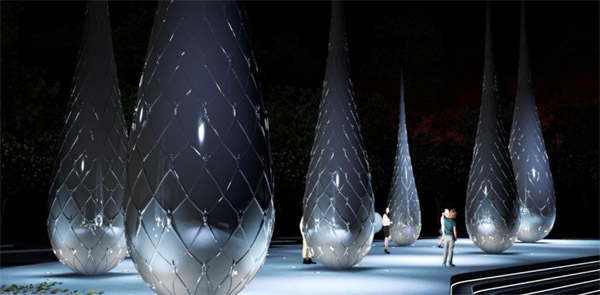
The immersive installation “Be Water” presents a visual narrative that delves into the multifaceted dimensions of water in nature and human life. Antuan’s creation of the Human Net, a human geometric structure visible in each sculptural piece, symbolizes the symmetry of the universe, elemental purity, and omnipresent wisdom. The characters within the installation represent the unity of humanity in the face of the urgent need to address the global water crisis, highlighting the essential collaboration between humanity and AI to create a new network of human consciousness. This interconnectedness is crucial in working collectively to tackle the challenges posed by the water crisis and establish a new order for the planet.
The installation places a particular emphasis on the intrinsic memory of water and explores how AI can effectively convey the significance of this vital element to humanity. This exploration seamlessly integrates art, science, space, metaphysics, energy, and the compassionate stewardship of our planet. By captivating audiences, “Be Water” aims to inspire a reconsideration of our relationship with water, shedding light on its potential to heal and sustain us through its memory. The “Be Water” installation represents a significant milestone in the ongoing art-science research led by the esteemed contemporary artist, Antuan. Building upon the success of the acclaimed project, “The Other Dimension,” which was showcased in an exhibition at the Museum of Contemporary Art in Miami, FL in 2017, “Be Water” continues to push the boundaries of artistic expression and scientific exploration.
DIVERSEartPB 2023
DIVERSEartLA is a prominent art platform, a rotating section of museums, art institutions and non-profits annually featured at the LA ART SHOW, Contemporary Art Fair in Los Angeles. By extension, DIVERSEartPB is the first edition of the same program at ART PALM BEACH. Its mission is to engage communities both locally and globally by connecting thought leaders and key figures within the art world to generate innovative ideas and drive social change through art.
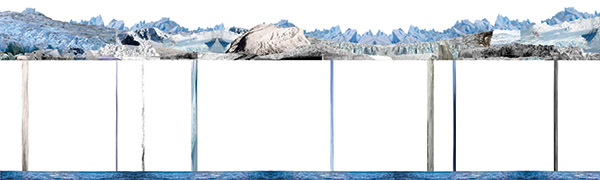
The 2023 ART PALM BEACH edition will feature Florida-based non profit organizations, international museums and artists participating for the first time in the fair, including internationally-renowned artist Marcos Lutyens, author of a powerful video art piece named “Particles”. The video installation was created specially for the IMAX Room at the Museum Sol del Niño in Mexico in collaboration with Collective Group Filamento and a collective project by Guillermo Anselmo Vezzosi (Visual Artist/Architect), and Dr. Eric Larour (Scientist V and Group Supervisor for the Sea Level and Ice Group in the Earth Sciences Section at the Jet Propulsion Laboratory –– JPL/NASA).
The goal of DIVERSEartPB 2023 is to view this sector of art within the show through ecological glasses. The curatorial focus of this first edition is at the heart of a growing number of art narratives, including exhibitions built with high-tech innovations, designed to inspire artistic appreciation and the desire to respond to environmental challenges. This reinforces the value of translating environmental advocacy into art and the ways to better understand its effects on our lives, the environment and the urgent need for action.
One of the most powerful things about art is that it brings people together, and transforms the way we communicate. This is done through immersive experiences and installations that invite visitors to consider potential solutions. Humans are changing the Earth’s natural systems in rapid and unprecedented ways. This has ushered our planet into a new geologic era: the Anthropocene. The questions we must all face: How do we navigate the changes that we have caused? How can we make a positive impact? Where do we find hope?
DIVERSEartPB is curated by Marisa Caichiolo, DIVERSEartLA Curator.
Project “The echo of oblivion”
Presented by 2b Non Profit Organization (Miami)
A collective project by Guillermo Anselmo Vezzosi (Visual Artist/Architect), Dr. Eric Larour
(Scientist V and Group Supervisor for the Sea Level and Ice Group in the Earth Sciences
Section at the Jet Propulsion Laboratory –– JPL/NASA)
Video project developed with the collaboration of José Luis Bongiovanni (Entrenautas)
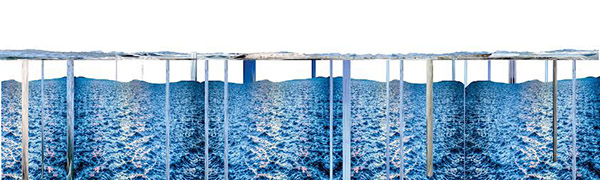
What is time other than a succession of events that we inevitably try to control as we begin to forget… As human beings, we are always willing to forget. Our essence is based on it, and we cannot avoid it because our existence also depends on it.The past ––once our present and also as longed for and imagined as our future–– is nothing more than a collection of facts, situations, events and circumstances that shape how we experience our present, which is nothing other than the reality we currently inhabit and a state in which we forget everything that we have already experienced.
Like an echo that momentarily exists in the environment as it tries to prolong its own existence yet ultimately disappears, we witness individual images appearing before us and merging into one as they claim their new essence.Old images from another time and era that have only been preserved due to harmony appear too before us. At a certain moment, and as a result of our presence, balance is lost, and we begin an inevitable, fearful journey towards oblivion.But as that eternal process of catching everything in the shadows of oblivion is being consolidated, we realize that we are simply mere observers, whose passivity has only accelerated a process that should have happened naturally. It is the same process that allows a solid to take on a liquid state and change its shape ––but not its essence. A liquid’s past existence can be conceived as rigid, stable and permanent, but once altered, it is inevitably active.And it is when science claims the present moment that reality takes over and the marriage between art and science can take place.
Scientific data and art merge into a dynamic work that allows for information to be transformed and reach those who have been victims of oblivion. Ultimately, the mere desire to exist pushes through in an attempt to reach the future and trigger the marriage between art and science. This scene comes together through a stable and dynamic melting background that takes on a liquid form and permeates everything around it. A series of lines floating over space evoke another presence. And this is where past, present and future meet.
While the echo is aware that it was born to have a brief existence and that it cannot fight against its own essence, it is our duty to prevent it from being devoured by the silent presence of oblivion.
Project “ASCENSO”
Artist : Samuel Domínguez
Sound Design: Francisca Bascuñán
Curator : Mahara Martinez (from Vitrina Lab)
Presented by Vitrina Lab / Arts Non Profit
and Tampa Museum
Three-channel 4K animation, stereo sound
Two minutes, loop
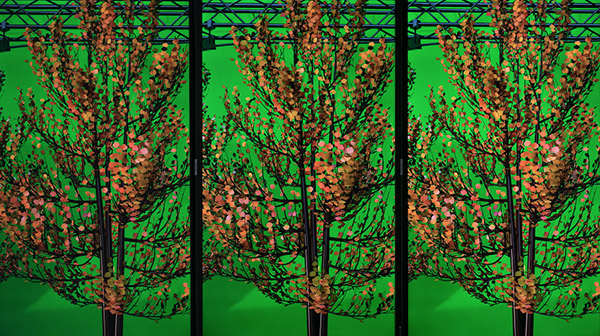
The artwork immerses the audience in a digitally-built artificial scenario. The trees, rocks, and fragments of soil are installed in what seems to be a film set, with steel structures (truss) and a chroma-green screen background, a technique used in post production to replace the background in films.
How do we navigate the idea of ‘landscape’ nowadays? How do we understand the territory under the notion of ‘natural’?
The animation shows a setting in which everything or nothing can happen, even a piece of timber floating without any reasonable explanation.
Finally, the music composition was designed by Francisca Bascuñán, by translating the data from the three-dimensional digital objects in the setting into sounds.
Project “PARTICLES”
Artist : Marcos Lutyens
Curated by Marisa Caichiolo
Created for Sala IMAX MUSEUM SOL DEL NINO / GRUPO FILAMENTO – MEXICO
Marcos Lutyens is a British interdisciplinary artist and author based in Los Angeles, California. His artworks seek to disrupt internalized patterns of thinking, associations, and ways of existing in the world through exhibitions and performances Lutyens´ artistic practice targets the psychic and emotional well-being of his audiences by skillfully leading participants in hypnotic exercises that affect the deepest levels of their psyche. His works take form in installations, sculptures, drawings, short films, writings and performances.
In his explorations of consciousness, Lutyens has collaborated with celebrated neuro-scientists V. Ramachandran and Richard Cytowic, as much as studying under shamans from different cultures. From these investigations and research he has worked with visitors´ unconscious states in museums, galleries and biennales around the world.
Lutyens was invited by the Solomon R Guggenheim Museum, NY to be keynote artist with the opening performance at Culture Summit 2019. Lutyens has exhibited in many museums and leading art exhibitions around the world, including the Royal Academy of Arts, Centre Pompidou, National Art Museum of China, Documenta, and the Biennials of Venice, Istanbul, Liverpool, São Paulo. In the time of COVID-19, Lutyens created a series of 12 zoom performances to help the healing process of people in various countries around the world, and is currently working on the national scale COVID-19 artwork Rose River Memorial which has been exhibited at various sites around the US including most recently, the Orange County Museum of Art.